Revenue is a seductive metric. When the numbers are climbing and the market is responding, it is easy to assume that the business is healthy. You are winning. You are scaling. You are gaining traction. But for many visionary founders, this period of outward success is often the exact moment where the internal engine begins to smoke.
Operational breakdown is rarely a sudden explosion. It is a silent creep. It starts with a missed email that was "flagged for later" but never revisited. It manifests as a lead that sat in an inbox for 48 hours because the team wasn't sure who owned the follow-up. It shows up as a founder who spent six hours on a Tuesday troubleshooting a software glitch or a scheduling conflict instead of architecting the next stage of growth.
When a business has traction but lacks a scalable operational architecture, growth becomes a liability rather than an asset. The very success you worked to build starts to create a level of friction that throttles your capacity, drains your energy, and eventually, begins to erode your reputation.
The Invisible Friction of the "Success Plateau"
Many founders find themselves stuck at a specific ceiling. You have the demand. You have the expertise. Yet, you cannot seem to move past your current level of output without everything feeling like it’s about to break. This is the success plateau: a state where your manual processes and individual heroics are no longer enough to sustain the volume of your opportunities.
1. The High Cost of Missed Leads
In a growing business, the greatest hidden cost isn't an over-budget marketing campaign; it’s the lead that never got a response. According to research cited in the Harvard Business Review, companies that respond to inquiries within an hour are seven times more likely to have a meaningful conversation with a key decision-maker than those who wait even sixty minutes.
When your operations are fragmented, "speed to lead" is the first thing to die. If your intake process relies on a founder’s memory or an assistant’s manual spreadsheet entry, you are leaking revenue. Growth doesn't just require more leads; it requires a system that ensures no lead is ever left to go cold.
2. Communication Overload and the "Noise" Tax
As your business scales, the volume of communication doesn't just increase: it compounds. Every new client, every new team member, and every new project adds layers of complexity to your internal and external dialogue. Without a central nervous system for your operations, this results in communication overload.
You find yourself repeating instructions, searching through three different platforms to find a client's specific request, and managing "urgent" notifications that shouldn't have reached your desk in the first place. This is a noise tax. It robs you of the deep work required to lead and replaces it with the frantic energy of a middle manager.
The Founder as the Ultimate Bottleneck
The most uncomfortable truth for many visionary leaders is that they are often the primary bottleneck in their own company. In the early stages, your personal involvement in every decision was a competitive advantage. It ensured quality. It protected the vision.

True operational efficiency is about removing the founder from the "doing" so they can return to the "architecting."
Identity Before Visibility: The Strategic Fix
At The SEG Company, we operate under a core philosophy: Identity Before Visibility.
Many leaders try to solve operational breakdowns by hiring more people or buying more software. They attempt to "scale their way out" of a bottleneck. But adding more visibility: more marketing, more sales, more reach: to a broken operational system only accelerates the breakdown.
Before you scale your external reach, you must align your internal truth. This means defining your operational identity:
- Who owns the outcome? (Not just the task).
- What is the "one source of truth" for data?
- How does information flow without manual intervention?
A Clarity Reset isn't just about organizing your files; it’s about architecting a foundation that allows your leadership presence to expand without your personal bandwidth collapsing.
Architecting the Future: From Manual to Intelligent Systems
Once the business problem is identified: the missed leads, the friction, the overload: we can begin to discuss the technical solution. In today’s landscape, the competitive advantage belongs to the leaders who bridge the gap between human-centric values and intelligent automation.
The breakdown happens because humans are being asked to do things that machines are better at: remembering to follow up, data entry, and cross-platform synchronization. By installing Intelligent Support Agents and automated workflows, you aren't replacing the human element; you are liberating it. You are giving your team (and yourself) the space to engage in high-level strategy and relationship-building while the system handles the heavy lifting of the operational mundane.

The Path Forward
Operational breakdown is not a sign of failure; it is a symptom of growth that has outpaced its current container. The question isn't whether you can work harder to keep the plates spinning. The question is whether you are willing to evolve the system itself.
If you are a founder who feels the friction of missed opportunities or the weight of a chaotic inbox, it is time to move from "hustle" to "architecture." You have built the traction. Now, build the foundation that can sustain it.
Work With Me
We help visionary leaders align their systems and leadership presence to achieve intentional growth. Whether through a Clarity Reset to untangle your operations or a Founder Advisory Session to refine your strategic direction, we architect the systems that support your next evolution.
Experience the System Live
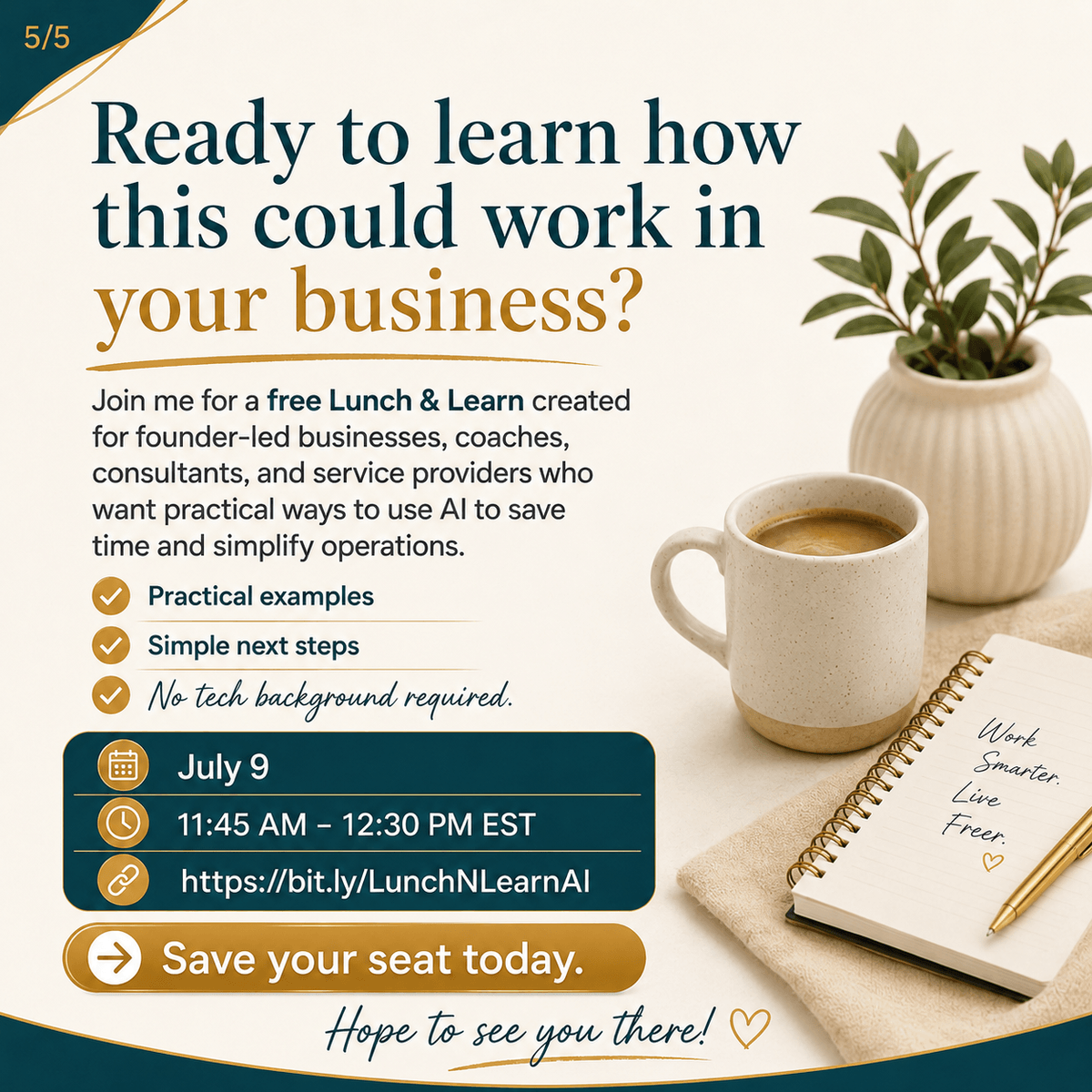
On Thursday, July 9, 2026, at 11:45 AM EST, I will be hosting a live Lunch & Learn. This is a no-fluff, 45-minute deep dive where I will demonstrate exactly how we untangle operational friction and build intelligent systems that work for you: not against you.
If you are ready to see what an architected business actually looks like in practice, I invite you to join us.
The SEG Company